TalentCards Research
The State of Deskless Workforce Training
Deskless workers make up 80% of the global workforce, and yet research has focused largely on their employers, until now. This survey, conducted by TalentCards, shines a spotlight on these deskless workers and the state of their training.
We surveyed 600 frontline workers from four countries, employed in a range of industries including healthcare, education, retail, and more.

The definition of deskless workers
Deskless workers, also known as frontline workers, are people who don’t do their jobs from behind a desk. Unlike people who work in traditional office settings, deskless employees are on their feet or on the move throughout their workday.
Some examples of these professions include nurses, teachers, salespeople, construction workers, truck drivers, and more.
Main findings: 1/9
Deskless workers enjoy being deskless.
Deskless workers, also known as frontline workers, are people who don’t do their jobs from behind a desk. Unlike people who work in traditional office settings, deskless employees are on their feet or on the move throughout their workday.
Some examples of these professions include nurses, teachers, salespeople, construction workers, truck drivers, and more.
64%
Said no when asked if they would switch to a desk job given the same pay and benefits
Discover their reasons
383
Respondents said they would not switch to a desk job given the chance.
Here are some of their reasons why:
“No, I enjoy not being chained to a desk.”
“No. I don’t like the idea of being stuck behind a desk. My job is very practical and hands-on.”
“No, I found that I became very unfit doing desk work.”
“Working behind a desk is monotonous and boring to me.”
“No, desk work is boring to me.”
“No, I’d much rather be hands-on and be out of the office, rather than be chained to a desk.”
“No. Everyone knows desk jobs are bad for your health. I’m basically being paid to exercise. I don’t need to work out when I get home from work because I’ve already burned a large number of calories over the course of my workday.”
Main findings: 2/9
What does training cover for deskless employees?
We asked deskless workers what types of training their employers have provided in the last 12 months. While compliance remains the most common topic, COVID-19-related training was not far behind.
Main findings: 3/9
The job may be deskless, but that doesn’t mean it’s tech-less
59%
Of respondents report receiving the majority of their training online.
Graph data
- Online, through a learning patform: 53%
- Offline (face-to-face, handbooks, shadowing, etc): 40%
- Online, over a mobile device: 6%
- Other: 1%
Main findings: 4/9
How much of that training gets remembered?
17%
Of respondents report they remember less than half of their training immediately after completing it.
32%
Thirty days after completing training, that number jumps to
Research on memory and retention over time shows that the forgetting curve is much steeper than respondents believe it to be. Comparing reported responses on retention to empirical data shows that employees consistently overestimate how much they actually remember.
Without reinforcement, this is what retention actually looks like:
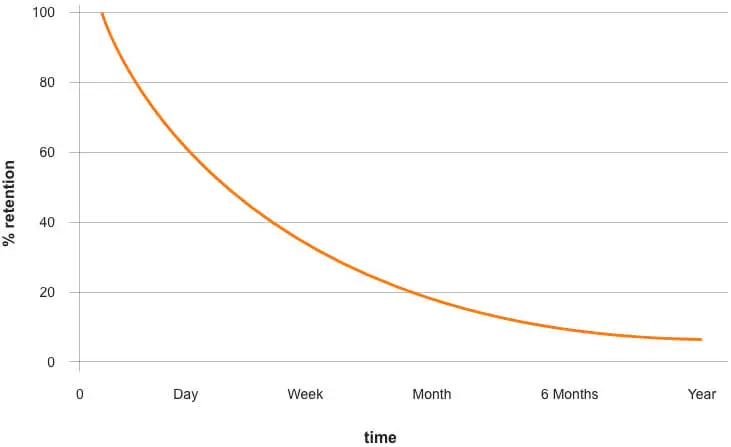
Takeaway: Reinforcement training is key for retention. Without follow-up training and review, employees will forget nearly 100% of what they learned after 30 days.
Main findings: 5/9
Does deskless mean disconnected?
19%
Of respondents feel “somewhat” or “very” disconnected as a result of working away from the central company location.
With deskless workers outnumbering desk workers 4 to 1 on a global scale, helping them feel connected to their company’s missions and values should be a top priority.
Tech may be a potential solution to solving this problem, since it helps eliminate the distance between deskless employees and their company’s central location. But a 2018 report shows that only 1% of software venture funding goes toward creating tech that would serve these frontline workers.
Main findings: 6/9
More training means more connected employees.
To help uncover solutions to decrease the disconnect that deskless employees feel, we asked respondents if access to additional training would help them feel more connected to their company’s values and mission.
63%
Said yes
Main findings: 7/9
What would make training more enjoyable?
Training has evolved from manuals and textbooks, but has it become any more enjoyable? We asked employees how their training experience could be improved, and here’s what they had to say:
Main findings: 8/9
Deskless employees want training that’s short, sweet, and consistent.
To help uncover solutions to decrease the disconnect that deskless employees feel, we asked respondents if access to additional training would help them feel more connected to their company’s values and mission.
80%
Prefer short training sessions that happen at regular intervals over long, one-time training events.
Main findings: 9/9
Deskless workers know they need to keep up with tech.
To help uncover solutions to decrease the disconnect that deskless employees feel, we asked respondents if access to additional training would help them feel more connected to their company’s values and mission.
56%
Of deskless employees believe that additional training will improve their chances of surviving in a job market that is constantly changing due to advancements in technology.
Deskless Workers and COVID-19
COVID-19 has made deskless workers feel more at risk.
When asked if they’d be willing to switch to a desk job with the same pay and benefits, 24% of respondents answered “yes”, while another 12% said “maybe”.
Here are some of their reasons why:
“I might consider it now because of the dangers of COVID.”
“I work in hospital emergency rooms, which feels much more dangerous given the pandemic. Would feel better protected behind a desk in an office.”
“Currently, with COVID, I would.”
“Yes, COVID has made me scared to work with the public. If I could do my job without that interaction for the same pay, I would.”
“Yes, the current pandemic puts me in close proximity to too many people.”
Which industries report the highest rates of COVID-related training?
As expected, healthcare comes in first place, with 82% of employees reporting having received COVID-related training in the last 12 months. But, surprisingly, education landed at the bottom, with only 52% of education employees reporting the same.
.
% of respondents who received training
Healthcare and Social Assistance
Graph data
- Yes: 82%
- No: 18%
n=124
Retail
Graph data
- Yes: 76%
- No: 24%
n=80
Hotel and Food Services
Graph data
- Yes: 74%
- No: 26%
n=43
Manufacturing
Graph data
- Yes: 69%
- No: 31%
n=29
Construction
Graph data
- Yes: 69%
- No: 31%
n=36
Transportation and Warehousing
Graph data
- Yes: 58%
- No: 42%
n=26
Education
Graph data
- Yes: 52%
- No: 48%
n=88
Is the future of training mobile?
Which device do deskless workers prefer most for training?
46%
Of respondents reported their preferred device for training is a tablet or smartphone. When we filter responses based on age group, that number increases in younger adults. And yet, only 6% of respondents reported that they received the majority of their training over a mobile device.
Millennials already make up the majority of the workforce, and while Baby Boomers continue to exit, Gen Z is entering. Younger adults’ preference for tablets and smartphones shows that mobile training will continue growing in importance in the years to come.
Respondents who chose a smartphone or a tablet as their most preferred device for training:
35%
of people aged 18-24
25%
of people aged 25-34
26%
of people aged 35-44
24%
of people aged 45-54
22%
of people older than 54
Takeaway: With only 1% of software venture funding going toward tech made for deskless workers, it’s likely that some respondents have never trained using a smartphone or tablet before. Only 6% of respondents reported receiving the majority of their training from a mobile device.
The result? Significantly more than 26% of respondents may prefer smartphones or tablets over desktops or laptops for training, but they just don’t know it.
Are company phones necessary for providing mobile training? Deskless employees say no.
74%
Of respondents report feeling “somewhat” or “very” comfortable with using their own personal mobile devices for training.
Mobile accessibility means employees can (and will) train from anywhere.
We asked employees where they’d prefer to complete training, if they could do it from anywhere. Here’s what they said:
Takeaway: Mobile training may be the undiscovered solution to many of the challenges that deskless employees face: feeling disconnected, difficulty accessing training, and having to take time away from the job to complete it.
And while a majority report that they prefer to complete training using a desktop computer, they may have never experienced mobile training before, and therefore have never considered it as a better alternative.
A closer look at training in each industry
Deskless workers’ jobs vary widely across different industries.
A closer look at the following four training statistics helps provide some insight into the nature of each industry’s different challenges and training policies:
- Soft skills training
- Preferred device for completing training
- Most common training challenge
- Retention rate
Healthcare and Social Assistance
46%
Have received soft skills training in the last 12 months
22%
Choose a smartphone or tablet as their most preferred device for completing training
44%
Report training taking too long to complete as an issue
29%
Remember less than half of their training 30 days after completing it
Education
48%
Have received soft skills training in the last 12 months
11%
Choose a smartphone or tablet as their most preferred device for completing training
60%
Report training taking too long to complete as an issue
51%
Remember less than half of their training 30 days after completing it
Retail
48%
Have received soft skills training in the last 12 months
30%
Choose a smartphone or tablet as their most preferred device for completing training
44%
Report training taking too long to complete as an issue
26%
Remember less than half of their training 30 days after completing it
Deskless training by country
35%
Receive the majority of their training offline
52%
Agree that more training would help them feel less concerned about the future of their jobs as a result of advancements in technology
56%
Agree that more training would help them feel more connected to their companies’ goals, missions, and values
87%
Receive performance feedback at least once a year
40%
Receive the majority of their training offline
69%
Agree that more training would help them feel less concerned about the future of their jobs as a result of advancements in technology
68%
Agree that more training would help them feel more connected to their companies’ goals, missions, and values
79%
Receive performance feedback at least once a year
41%
Receive the majority of their training offline
49%
Agree that more training would help them feel less concerned about the future of their jobs as a result of advancements in technology
64%
Agree that more training would help them feel more connected to their companies’ goals, missions, and values
81%
Receive performance feedback at least once a year
51%
Receive the majority of their training offline
67%
Agree that more training would help them feel less concerned about the future of their jobs as a result of advancements in technology
73%
Agree that more training would help them feel more connected to their companies’ goals, missions, and values
83%
Receive performance feedback at least once a year
(250 respondents)
Who we surveyed
In an effort to obtain a representative sample of the deskless workforce, we surveyed 600 deskless employees from the US, the UK, Canada, and Australia.
Respondents were all employed for wages, had received training from their employers in the last 12 months, and were at least 18 years old.
Graph data
- Other: 29%
- Healthcare and social assistance: 21%
- Education: 15%
- Retail: 13%
- Hotel and food services: 7%
- Construction: 6%
- Manufacturing: 5%
- Transportation and Warehousing: 4%

Athena Marousis

With degrees in both English and Economics, Athena strives to combine the power of words with the precision of numbers. She is passionate about creating quality content that not only reads well but is also data-driven and evidence-based.